Our sustainability efforts
Personnel

The average age of our personnel increased slightly from the previous year (2024: 49.5 years).
The actual work contribution, excluding overtime and on call duty was
The number of employees and person-years worked decreased slightly from the previous year. The change in the number of personnel has been influenced by factors such as the ongoing organisational changes at Finnish Customs. Because of these changes, we have not been able to recruit new personnel to replace those who have left. A person-year refers to the regular normal working hours during one year, excluding overtime and other work not included in the normal working hours. Paid or partially paid sick leave does not reduce the number of person-years worked. The maximum number of person-years for a full-time employee is always one.
Work

The number of people in public-service employment relationships remained the same as it was in 2024. The number of people doing period-based work remained the same as it was in 2024.
The number of people working remotely increased slightly from the previous year (2024: 806). In 2025, the number of remote working days per person-year was 70. The average number of remote working days remained almost unchanged (2024: 168).
The personnel’s experiences of Finnish Customs as a workplace
The results are on a scale of 1–4. In 2025, Finnish Customs introduced a new job satisfaction survey called HenkilöstöBaro. Previously, the VM Baro survey was used. Because the surveys differ from each other, it is not possible to compare the results with those of previous years.
The sustainability index measures social responsibility, how your organisation treats people and society, and whether well-being at work, working conditions, equality and non-discrimination are realised. Typically, a work community with a high level of social responsibility is an attractive employer that fosters commitment.
Read more
Finnish Custom's Year 2025: Year in figures
The operating environment of Finnish Customs is undergoing a significant change. The state of the world has been increasingly characterised by unpredictability and changes in the security environment. As part of the implementation of the 2025–2029 strategy, Finnish Customs began preparing for organisational reform in early 2025. That organisational reform is a response to the changes in the operating environment, and it guides Finnish Customs towards the role of a security authority. This has also required an amendment to the Act on the Administration of Finnish Customs. The legislative reform amended provisions concerning the internal administration of Finnish Customs so that we can specify certain matters in our rules of procedure. There were no changes to our duties or services. Now that we can define essential matters in the rules of procedure, we are better equipped to respond to the demands placed on Finnish Customs by the changing operating environment, among other things. The planned legislative reform came into force on 1 January 2026.
Cooperation negotiations also began at Finnish Customs in May 2025. Russia’s invasion of Ukraine, and the subsequent closure of Russian border crossings to freight and passenger traffic, has affected the assignments of Finnish Customs’ personnel and their regional distribution. The grounds for the cooperation negotiations were changes in Finnish Customs’ organisation and duties and the locations of official positions in different regions. For this reason, the cooperation negotiations included lay-offs as an option, but reductions in personnel were not their aim.
Consensus was reached in the cooperation negotiations in November 2025. The new organisation of Finnish Customs will come into effect on 1 April 2026.
Finnish Customs uses the HenkilöstöBaro job satisfaction survey. The Finnish Government Shared Services Centre for Finance and HR (Palkeet) is responsible for maintaining and developing the survey. The development of the survey is steered by the Ministry of Finance.
Of Finnish Customs’ personnel, 68% responded to the HenkilöstöBaro survey. The survey focused on four areas: one’s own work, the work community, management and the organisation. Of these areas, one’s own work was rated highest (a score of 3.2 on a scale of 1–4) and the organisation was rated lowest (with a score of 2.7). According to the survey, many of the personnel of Finnish Customs feel that they can be themselves in their work community and do meaningful work and that they want to be heard when decisions affecting them are made. The work of the supervisors garnered praise for trust, fairness and supporting the employees, among other things.
This year, the overall job satisfaction index was 3. The result is at a good level according to the limits set by Palkeet. The result can also be considered good in light of the ongoing changes in the organisation.
Support available for the changes
Traditional development sessions will not be held this year to review the results for 2025. Instead, sessions led by supervisors will be held to discuss what kind of practices can support the ability to cope with work strain and improve well-being in the team. The sessions emphasise resilience, i.e., the skills that can help people cope with challenging situations due to change.
In addition, a page titled “Muutoksen tueksi” (Support for Change) has been launched on the intranet of Finnish Customs. The page contains information and tips on how to take care of your well-being at work during times of change. In addition, the Moment of Well-being sessions that are open to everyone have focused on supporting the personnel during the change.
Finnish Customs engages in various forms of training-related cooperation with different educational institutions, partners and customers. When different stakeholders have expertise in customs matters, both current and future professionals in the trade sector will be able to act according to protocol and they will need less assistance in handling customs matters. Finnish Customs’ own personnel are trained in basic tasks by using an apprenticeship model, which requires cooperation between a vocational college (Eduko) and our own training staff. We also invest in developing the skills of our personnel throughout their careers.
In numbers: we organised customer and stakeholder training courses in total
Higher education institutions are among our long-term partners in raising awareness about customs matters. We have taught the basics of import and export and explained the role and importance of Finnish Customs in international trade at Lappeenranta-Lahti University of Technology LUT and Turku University of Applied Sciences (Turku UAS) for several years. The cooperation continued last year. Customs-related study modules at higher education institutions increase knowledge about the duties of Finnish Customs and create a positive image of Customs as a potential workplace.
Close cooperation in connection with training has also been carried out between the PCB partners, that is, the Police, Finnish Customs, the Finnish Border Guard and the Finnish Security and Intelligence Service. The aim of joint training is to enable authorities to support the security of society as effectively as possible in key areas of activity.
In 2025 there were training days
Finnish Customs’ personnel actively participated in local, remote and online training. Training is held as remote and online training whenever appropriate. The number of training courses organised was slightly lower than in the previous year (2024: 10/person-year), as there were fewer extensive, longer-term training programmes and basic training groups. The organisational reform also had an impact on the training situation.
Finnish Customs is engaged in long-term efforts to build its image as an employer. Because young people are the professionals of the future, we want to capture their attention at an early stage. In 2025, we focused especially on youth cooperation by organising a campaign aimed at young people in addition to various events.
“Why not pull on your gloves!” – this successful campaign spoke to people
In the autumn of 2025, we ran a campaign aimed at students in higher education institutions in collaboration with Yliopistomedia. The campaign was visible from October to December on the premises of a total of seven higher education institutions across Finland. The campaign was also visible on the website of Finnish Customs, in social media channels and at events in November. In addition, the redesigned badge for student union overalls became so popular that even the media took note of it.
We directed interested students to the campaign page, where we had compiled information targeted specifically at students. Based on the website analytics, the tongue-in-cheek campaign attracted attention, and students found the content of the page interesting.
The campaign page was visited over
The average time spent on the website of Finnish Customs was 2.5 minutes.
Events and encounters with various target groups
We strive to be visible at a wide range of events and reach young people throughout Finland. Visits to comprehensive schools are one of our key ways of reaching young people. During the visits, Finnish Customs’ personnel talk about their work. They also explain during the visits why various restrictions and prohibitions are important for the safety of society, such as those relating to e-cigarettes and counterfeit products
In addition to visiting educational institutions, we organise events or participate in various events organised by others. In June 2025, for example, we participated in a hybrid event organised in collaboration with the LOGY Young Professionals platform of the Finnish Association of Purchasing and Logistics LOGY, which was intended for students and recent graduates in the field of logistics. The presentations of Finnish Customs at the event focused on the trade war, enforcement of sanctions and Customs as a workplace.
In November, we also participated in two student events, Aalto Talent Expo and Studia. At the Aalto University event, we met university students from various fields, while the main target group at Studia consisted of general upper secondary school students. At both events, we had good discussions with young people, explained the role of Finnish Customs as a security authority and presented career opportunities in our organisation. During our discussions, we noticed that some of the young people knew they wanted to work for Finnish Customs or one of the security authorities in general. This shows that long-term work on image building pays off.
In 2025, an internship related to studies at Finnish Customs was completed by
Of the trainees, three completed the compulsory unpaid practical training period included in their studies. The remaining five trainees completed paid higher education internships.

Indicators
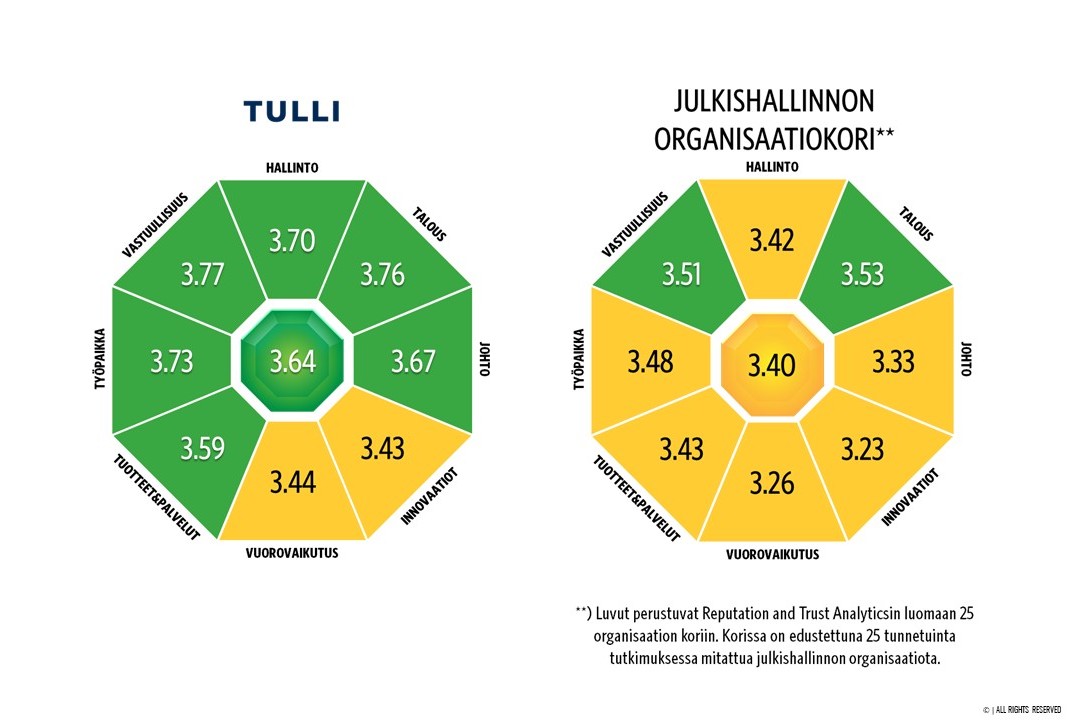
Elements of Finnish Customs’ reputation in the Reputation&Trust survey
Image: Finnish Customs’ reputation ratings compared to a basket of public administration organisations