Free trade agreement between the EU and Mercosur countries
This page contains guidance for importers and exporters.
The free trade agreement between the EU and the Common Market of the South – that is, the Mercosur countries Argentina, Brazil, Paraguay and Uruguay – will enter into force provisionally on 1 May 2026.
For the first time, the agreement lays down the rules of origin to be applied in the trade between the EU and the Mercosur countries and provisions on providing proof of origin.
Under the agreement, the customs duties will be either immediately lowered on 1 May 2026 or gradually reduced 5, 8, 9, 11 or 16 years after the agreement’s entry into force, depending on the product group. The schedule for the phase-out of the customs duties and any exceptions for different product groups can be found in Annex 2-A to the agreement (Tariff elimination schedule).
Rules of origin
From 1 May 2026, goods are entitled to preferential treatment when they are imported to the European Union or the Mercosur countries provided that they fulfil the rules of origin established in the agreement and that acceptable proof of origin is provided.
The rules of origin of the free trade agreement between the EU and the Mercosur countries can be found in Section A of Chapter 3 of the agreement. The product-specific rules of origin are presented by commodity code heading in Annex 3-B of the agreement, and their application is further specified by the introductory notes to these rules provided in Annex 3-A.
Acceptable proofs of origin
The products’ eligibility for preferential treatment is demonstrated by a proof of origin that the importer must present at customs clearance.
The following proofs of origin are accepted:
- a statement on origin made out by the exporter
- a statement on origin in the form of a certificate endorsed by the delegated authority of the exporting country (only used in exports from the Mercosur countries).
The statement on origin made out by the exporter has a specific format. It can be made out on the invoice or some other commercial document where the originating products are described in sufficient detail so they can be identified by Customs. The statement on origin can only cover one import consignment.
The statement on origin is valid for 12 months from the day it was made out, and it must be presented to the customs authorities of the importing party within this time limit. Exceptions can be made to this time limit if the goods have been presented to Customs within the time limit, for example when being placed under the customs warehousing procedure.
Making out the statement on origin in the EU
All EU exporters can issue statements on origin for consignments that contain originating products for a maximum value of 6 000 euros. If the consignment exceeds this value, only companies registered in the REX system can submit a statement on origin. In such cases, the statement on origin made out by the company must include the FIREX number that the company obtained when registering in the REX system. The FIREX number must also always be provided when the company has such a number, even though the value of the consignment does not exceed the threshold of 6 000 euros.
If a Finnish exporter has already obtained a FIREX number by registering as an exporter of EU-originating products to, for example, Chile, the United Kingdom or Japan, the same FIREX number is also used in statements on origin when exporting goods to the Mercosur countries.
Making out the statement on origin in the Mercosur countries
As an exception to the provisions on the use of statements on origin in the agreement between the EU and the Mercosur countries, two different forms of the statement on origin are introduced in the initial stage for exporters in the Mercosur countries. This exceptional procedure will be applied as follows:
- The exception will be applied for 3 years from the entry into force of the agreement, that is, from 1 May 2026.
- The exception may be extended for a maximum period of 2 years if the parties so decide.
The origin of goods exported from Argentina, Brazil and Uruguay can be proved either with
- a statement on origin made out by the exporter in accordance with the agreement, or
- a separate statement on origin given in the form of a certificate granted by the chamber of commerce of the Mercosur country or some other delegated authority of that country.
During the initial phase of application of the agreement, Paraguay will exclusively use a statement on origin in the form of a certificate. This means that, for the time being, exporters in Paraguay do not themselves make out the statement on origin required under the agreement.
The table below shows the proofs of origin applicable in the different Mercosur countries:
Mercosur country |
Statement on origin (in accordance with Annex 3-C) |
Statement on origin in the form of a certificate (in accordance with Annex 3-D) |
Argentina |
X |
X |
Brasil |
X |
X |
Paraguay |
|
X |
Uruguay |
X |
X |
The business IDs to be provided on the traditional statement on origin made out by the exporter in the different Mercosur countries are as described in the following examples:
- Exporters in Argentina provide the business-specific CUIT number (“Clave única de identificación tributaria”), which is made up of 13 digits in the following format: 12-12345678-1.
- Exporters in Brazil provide the business-specific CNPJ number (“Cadastro Nacional da Pessoa Jurídica”), which is made up of 14 digits in the following format: 12345678/1234-12.
- For the time being, exporters in Paraguay only make out certificates, and the Commission has not provided any business ID in its guidance.
- Exporters in Uruguay provide the business-specific RUT number (“Registro Unico Tributario”), which is made up of 12 digits in the following format, where the first digits are always “22”, followed by 10 business-specific digits: 22-123456-123-1.
The Mercosur countries do not apply the threshold of 6 000 euros, so the business ID must always be provided in the statement on origin regardless of the value of the consignment. Customs rejects requests for preferential treatment that are based on statements of origin made out with insufficient information.
Example of a statement on origin under the EU-Mercosur free trade agreement:
The exporter of the products covered by this document (exporter reference no… (1)) declares that, except where otherwise clearly indicated, these products are of … preferential origin (2).
…………………………………………………………….......................................(3)
(Place and date)
...……………………………………………………………………..............................(4)
(Name of the exporter)
The business ID of the exporter is indicated in field (1):
- EU exporters are to enter their REX identification number.
- Exporters in Mercosur countries are to enter their own national business identification number.
- You can read more about the REX number and the format of the business IDs of the different Mercosur countries under “Statement on origin made out by the exporter” on this page.
The origin of the product is indicated in field (2):
- The origin symbol for goods originating in the European Union is “European Union”, “EU” or the equivalent term for the EU in the national language of the country (e.g. “UE” in France”).
- The Mercosur countries enter the origin as “Mercosur”. It is not possible to use the national country identifiers for these countries.
If needed, the place and date is indicated in field (3). The place and date can be left out, if these details can be found on the commercial document that the statement on origin is made out on.
If needed, the signature is provided in field (4):
- Exporters in EU countries do not need to sign the statement on origin. This is based on the European Commission’s guidance on procedures for EU exports.
- Exporters in the Mercosur countries must add a signature, either digitally or by hand. Without the signature, Customs cannot accept the statement on origin.
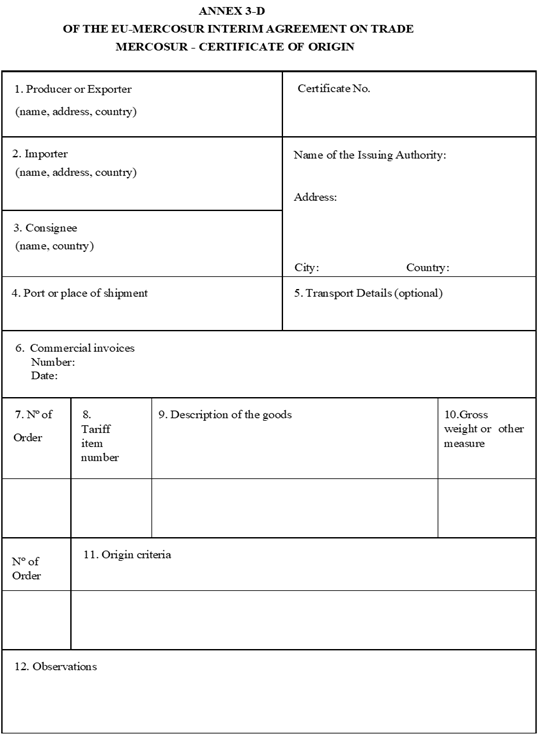
Statements on origin in the form of a certificate are only used in exports from the Mercosur countries, and the certificate is the same in all Mercosur countries.
The authority delegated to endorse the certificates in a Mercosur country is the chamber of commerce of that country or some other delegated authority. The certificate can be made out in English, Portuguese or Spanish. The exporter must always sign the document and it must contain an endorsement by the authority. However, the business ID is not required.
All the provisions on the statement of origin laid down in Chapter 3 of the ITA (validity, record-keeping, verification, etc.) are also applied to the statement on origin in the form of a certificate.
The image shows a model for the certificate from Annex 3-D.
How to provide the request for preferential treatment in the import declaration
When you request preferential treatment for a product originating in a Mercosur country, you should provide the following details in the import declaration:
- Provide 300 as the preference code.
- Provide the document code for the statement on origin, U126, which is the same for all the proofs of origin that are used. As the document identifier, you must provide the number of the document or separate certificate on which the statement on origin has been provided.
No documents are to be attached to the customs declaration, but they must be presented to a customs authority on request.
Requesting preferential treatment after import
Importers can request preferential treatment retroactively if they have not requested it when the goods were declared for release for free circulation. The statement on origin must be presented in the importing party no later than 2 years after the import of the products.
Cumulation of origin
Under the agreement,
- full cumulation is applied between the Mercosur countries
- bilateral cumulation is applied between the EU and the Mercosur countries.
Materials that have obtained originating status in the Mercosur countries or in the EU can be used in the other party as originating materials.
Tolerance rules
The agreement contains a general tolerance rule according to which non-originating materials can be used for a value of up to 10% of the ex-works price of the product, unless the product-specific rule of origin specifically prohibits this.
For textiles falling under Chapters 50 to 63 of the HS nomenclature, specific tolerance rules are laid down in Notes 6 and 7 to Annex 3‑A of the rules of origin.
Accounting segregation
The agreement allows the use of accounting segregation of originating and non-originating fungible materials.
This means that operators can store originating and non-originating materials of the same commercial quality and with similar technical and physical properties without physically segragating them from each other. The stored materials of different origin and their quantities can be supervised simply by using an accounting method.
Prohibition of drawback
The agreement does not include a prohibition of drawback.
Transitional measures
Products dispatched before 1 May 2026 may receive preferential treatment if they fulfil the agreement’s rules of origin and a statement on origin has been made out for them.
Product-specific rules of origin
The product-specific rules of origin have been drawn up in accordance with the EU’s new trade agreements. For several products, they contain alternative ways of fulfilling the origin requirements, such as
- a change in tariff classification (at the chapter, heading, or subheading level)
- a value‑ or weight‑based limitation on the use of non‑originating materials
- a specific manufacturing process, or
- combinations of these.
Most products of chemical industries have three different options for obtaining originating status, such as
- CTSH, meaning a change of tariff classification at the subheading level
- a chemical reaction
- a maximum threshold of 50% for the use of materials originating in third parties (the MaxNOM rule)
Examples of alternative ways to fulfil the origin requirement:
- For several products of Chapters 47–48, such as pulp (Chapter 47), paper and paperboard (chapter 48) and products of the printing industry (Chapter 49), there is the option of a change in tariff classification or the 50% MAXNom rule. The same goes for most of the machinery and appliances, Chapters 84–85, such as for accumulators for electric cars, heading 8507.
- For cars and other vehicles belonging to headings 8701–8707 there is only a 45% maximum threshold for use of materials originating in third countries.
- For instruments of Chapter 90, which include, among others, various precision instruments and medical devices, the product‑specific rules generally provide either a change of tariff heading (CTH) or the 50% MaxNOM rule as an option. This chapter includes certain exceptions where the products are subject only to a 45% or 50% MaxNOM rule.
Please note that Annex 3-A (introductory notes) and Annex 3-B (product-specific rules) to the agreement are based on the HS nomenclature that entered into force on 1 January 2017. You can check the correspondence of the headings referred to in the agreement with the latest HS nomenclature, updated in 2022, in the correlation table published on the World Customs Organization (WCO) website: Correlation Tables HS 2017 – 2022.
Read more
- The EU Commission’s website providing general information about the EU-Mercosur agreement: EU-Mercosur agreement
- The Commission’s guidance on the EU-Mercosur agreement: “EU-Mercosur ITA – Guidance on Rules of origin”
- Text of the EU-Mercosur interim trade agreement published in the Official Journal of the European Union
- Ministry for Foreign Affairs of Finland: Provisional application of EU–Mercosur agreement to begin: immediate tariff reductions available for companies (bulletin 23.4.2026)