The world around us is changing rapidly and becoming increasingly more difficult to predict. Finnish Customs must be able to respond quickly and effectively to incidents and changes in security policy. This was proven once again by the incident involving the vessel Fitburg on New Year’s Eve. For this reason, we focused on preparedness and capability building in 2025, and we will continue this work in 2026.
The importance of the Baltic Sea region to Finland’s economy, security of supply and resilience has grown, and Finnish Customs must be prepared for security threats to ports and international traffic. Ports are logistics hubs that attract growing organised crime to infiltrate flows of goods in international supply chains. In February 2025, the Government of Finland published its strategy to combat organised crime for the period 2025–2030, in which port security emerged as a key theme. Finnish Customs leads the port security project as the authority that monitors traffic crossing Finland’s borders.
The results of Finnish Customs’ crime prevention activities show that focusing on recovering the proceeds of crime and monitoring cash flows has been worthwhile. Concerning narcotics, the number of seizures remained high. The smuggling and use of alpha-PVP in particular was highlighted in 2025. The use of alpha-PVP, known on the street in Finnish as “peukku” (meaning “thumb”) sparked a lot of public debate, in which Finnish Customs also actively participated.
Public discussion on Russia’s invasion of Ukraine continued and took on new nuances as peace negotiations progressed. The situation on the eastern border remained unchanged, however. At Finnish Customs, we have focused on preventing the circumvention of sanctions imposed on Russia and ensuring their effectiveness. The enforcement of sanctions highlights Finland’s role as a reliable partner in cooperation with other EU border states.
In this section, we will provide more detailed information with examples about the role of Finnish Customs in protecting our society, monitoring the import of restricted and prohibited substances and combating cross-border crime.
Our sustainability efforts
In 2025, the number of criminal matters reported to Finnish Customs decreased from the previous year, but due to criminals becoming more efficient, the size of individual shipments of smuggled goods increased.
In 2025, the impact of Finnish Customs’ crime prevention activities was significant, totalling EUR 82 million; this reflects the successful targeting of Customs’ activities.
In 2025, Finnish Customs was aware of 5,078 criminal cases, around 450 fewer than in the previous year. With the closure of the eastern border, regulation offences and cases of tax fraud have decreased, but the number of seizures and confiscations of various prohibited substances and restricted products have increased. The number of tax fraud cases investigated by Finnish Customs has also decreased due to the Supreme Court ruling of June 2024, stating that cases of snus smuggling will no longer be investigated as tax fraud. The most common type of tax fraud involves the smuggling of tobacco products. In 2025, approximately 16.5 million cigarettes were seized, which is by far the highest amount in the last 10 years (7.1 million in 2024).
The number of narcotics offences also decreased. In 2025, Finnish Customs became aware of 1,751 narcotics offences (2,055 in 2024), 392 of which were aggravated (562 in 2024). Finnish Customs seized a total of 2,574 kg of narcotics, which was over 500 kg more than in the previous year. The quantities of cocaine and khat in particular increased. In addition, record amounts of the designer drug alpha-PVP and drugs classified as narcotics were seized. Foreign nationals have taken on a larger role in drug crime. In 2025, the share of foreigners suspected of aggravated narcotics offences investigated by Finnish Customs rose to 62%.
Violence linked to organised crime is on the rise. In 2025, Finnish Customs recorded 207 firearms offences in total, which is significantly more than in previous years (154 offences in 2024). Approximately twice as many weapons were also seized compared to previous years, totalling 689. Most of the weapons were gas weapons. Unauthorised military weapons and explosives coming from war zones as well as 3D-printed weapons ending up in illegal trade pose a new threat. 3D-printed weapons and parts of weapons are becoming more common in criminal circles, and they have also been found in criminal cases investigated by Finnish Customs.
Read more
Finnish Customs' Year 2025: Year in figures
Finnish Customs Enforcement 2025: Crime situation, Crime statistics
During 2025, Finnish Customs was involved in several cases related to enforcement, the most notable of which was the case involving the cargo vessel Fitburg. The police and the Border Guard stopped the vessel on suspicion of causing cable damage. With the assistance of the authorities, the vessel was brought into the port without the legally required declarations regarding its cargo. The investigation of the situation was transferred to Finnish Customs when preliminary information indicated that the cargo might contain products subject to EU sanctions.
Customs conducted a thorough inspection of the vessel, examining its structures, reviewing the shipping documents and physically inspecting the goods. The inspection found that the vessel was carrying structural steel originating from Russia. According to the expert assessment by Finnish Customs, the cargo fell within the scope of EU sector-specific sanctions, meaning that importing it into the EU was prohibited. The cargo was immediately confiscated for further investigation of the conditions for import, and Customs launched a preliminary investigation to assess the possibility of a sanctions offence. The preliminary investigation was terminated, however, when it became apparent that there was no evidence of an intentional violation of sanctions legislation.
At the turn of the year 2024–2025, Finnish Customs also investigated another major case involving the vessel Eagle S, which was carrying fuel products subject to sanctions against Russia. The vessel was carrying unleaded petrol and diesel fuel, which were interpreted as products subject to sanctions. The preliminary investigation by Customs found that the Eagle S had entered Finnish territorial waters at the request of the authorities and that the crew had not acted intentionally or violated sanctions legislation. In this case as well, the investigation by Customs led to the termination of the preliminary investigation after the Deputy Prosecutor General had been consulted.
In connection with these cases, Finnish Customs cooperated closely with the Ministry for Foreign Affairs to ensure that sanctions legislation was applied appropriately. In addition, Customs investigated whether the vessels or their owners were subject to entity-specific sanctions. International cooperation between authorities ensured, among other things, the authenticity of transactions, the destinations of the cargo and vessels and that the vessels and their cargoes did not end up in other EU ports after leaving Finland.
The Fitburg and Eagle S cases highlight the key role of Finnish Customs in enforcing EU sanctions and the importance of cooperation between authorities in effective sanctions enforcement. Both cases confirmed Customs’ readiness to respond to exceptional situations, ensure the legality of imports and promote national security within the framework of international regulations.
Read more
Finnish Customs has completed the preliminary enquiry into a suspected regulation offence by the crew of the ship Eagle S
Finnish Customs: The cargo of the vessel Fitburg consisted of sanctioned steel products
Changes in security policy and new types of incidents during normal times require Finnish Customs to respond quickly to changing circumstances and to adapt to the prevailing situation. Russia’s invasion of Ukraine has changed the operating environment permanently. Organised crime is also becoming more international and is operating more professionally, making extensive use of logistics hubs such as ports. In fact, Finnish Customs must be prepared for security threats to ports and international traffic as well as other exceptional situations.
Preparedness through training and planning
Finnish Customs has been participating in various preparedness exercises in cooperation with other authorities for several years, especially in local defence exercises in different parts of the country. Customs has also identified critical stakeholders, information systems and services and updated its preparedness plan. The plan has been approved as a draft, and it will be implemented when the new organisation of Finnish Customs comes into effect on 1 April 2026.
In addition to cooperation with multiple authorities, it is also important to practice Finnish Customs’ internal preparedness. Last year, Customs organised a two-day preparedness seminar. The lessons learned from the seminar are practiced at Customs. This allows us to identify additional concrete needs and further improve our capabilities.
Safety through strengthening the CBRNE capabilities
CBRNE refers to the threats arising from the misuse of or accidents involving chemical (C), biological (B), radiological (R), nuclear (N) and explosive (E) materials. The national CBRNE strategy designates Finnish Customs as the key CBRNE operator for monitoring CBRNE threats. The primary objective of the monitoring is to ensure the safety of supply chains for imported goods and, at the same time, prevent risks to society, people and the environment.
Finnish Customs has strengthened its CBRNE capabilities in recent years. In 2025, Customs collaborated with the RescEU disaster response and stockpile project, which maintains a stockpile in case of CBRN accidents and incidents as part of the EU Civil Protection Mechanism. The stockpile contains CBRN protective equipment, measuring devices, support equipment and CBRN medicines and antidotes.
We also arranged a training exercise with the police, rescue services and a logistics operator to strengthen cooperation between the authorities and the business community in threat and risk situations. In addition, we tested surveillance technology suitable for the duties of Finnish Customs and participated in an international funding project for the equipment. The hazardous substance control experts trained in Customs’ CBRNE project have supported the sampling of waste transports, among other things, and they also participate in the improvement of port security.
During 2026, Finnish Customs will begin training additional CBRNE specialists and organising as well as further developing CBRNE training for all personnel. Customs also has preparedness-related duties as well as monitoring, inspection and sampling tasks related to traffic involving a CBRNE risk.
Learn more about the RescEU project and training exercise by the authorities:
Read more
RescEU stockpile project (Ministry of the Interior)
RescEU - European Civil Protection and Humanitarian Aid Operations (European Comission)
Finnish Customs Enforcement 2025: Preparedness and capabilities are in good shape at Finnish Customs
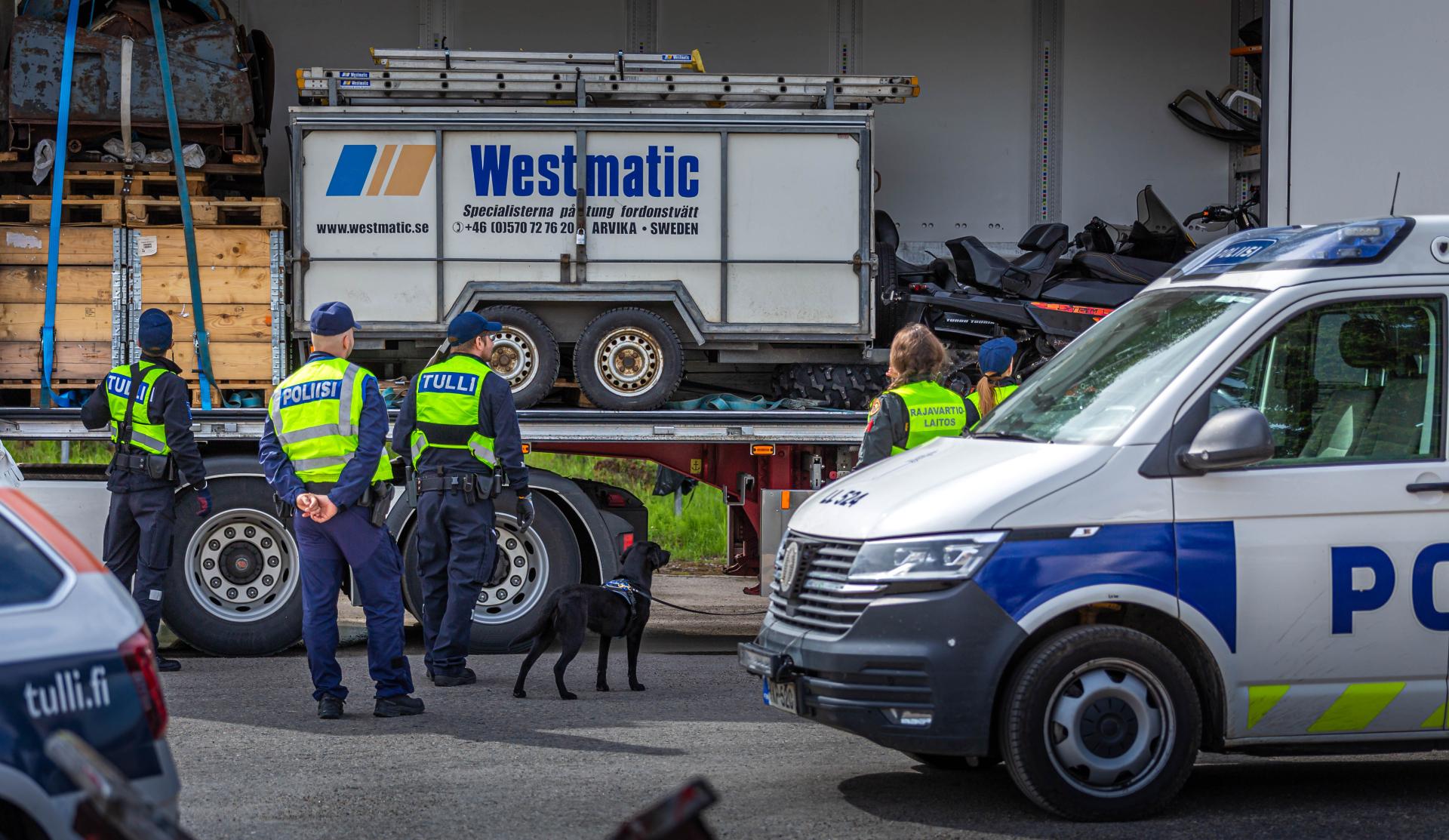
Sea transport is vital for Finland’s foreign trade, because more than 95% of our foreign trade is carried by sea from Finland to other parts of the world and vice versa. Ports as international logistics hubs are an integral part of Finland’s critical infrastructure. Finnish Customs is the only Finnish security authority present at all Finnish border crossing points with the capacity, equipment and authority to monitor all traffic across Finland’s borders, including at ports. The prevailing security environment is so unstable and unpredictable that the protection of critical infrastructure in particular is now receiving special attention.
Action plan to combat organised crime at ports
In February 2025, the Finnish Government adopted the government resolution on a strategy and action plan to combat organised crime (2025–2030). The action plan included in the strategy contains 21 measures in total; the ninth measure is entitled “Improving port security”. Finnish Customs has been identified as the primary responsible body for the measure. The measure in question specifies a number of different actions to strengthen port security and ensure the uninterrupted operation of ports. The aim of the measures is to combat and prevent organised crime from operating in ports and infiltrating the structures of legal business closely linked to ports.
To achieve these aims, Finnish Customs has set up a working group with representatives from ministries, other authorities and organisations from the port, transport, and logistics sectors. If necessary, the working group will also consult other experts. The operation of the working group began in 2025 and will continue until the end of 2030.
Read more
Finnish Customs Enforcement 2025: Port security will be improved under the leadership of Finnish Customs
Finnish Customs combats organised crime by strengthening port safety – cooperation, changes to legislation and international efforts protect the sea transport hubs
European Customs Alliance for Borders (EUCAB) is an EU-wide expert group that aims to streamline and harmonise operational cooperation between the customs authorities of EU Member States at all border crossing points in ports and at land borders and airports. The expert group’s work focuses on harmonising customs operations at EU border crossing points, identifying common risks and strengthening resilience, developing the skills of the personnel and building and harmonising technological capabilities. EUCAB, which operates under the Customs Programme, utilises the results and methods of its predecessor, the Customs Eastern and South-Eastern Land Border Expert Team (CELBET).
EUCAB began operations in March 2025 and is scheduled to operate until the end of 2026. EUCAB’s work is based on the results of four operational units and networks built around different topics. During the operating year, all units and networks organised themselves and began working to achieve the targets set for them. A total of 174 targets have been set for all working groups for the entire duration of EUCAB’s operating period, 27 of which had been achieved by December 2025. The targets vary from assessing the weaknesses and strengths of border crossing points to matters such as organising training or joint operations. All units mapped their training needs, and the first training courses will be organised during 2026.
Finnish Customs is strongly represented in various EUCAB groups, as we want to participate actively in promoting the creation of a safer and more unified Europe. Finland has a total of 18 representatives in various EUCAB units and networks. Finnish Customs played a significant role in CELBET, the predecessor of EUCAB, in promoting the development of a border crossing point assessment tool and the creation of centres of expertise for organising training between Member States. Customs also promoted the secure exchange of information on risks and threats. EUCAB is a natural continuation of the efforts to enhance EU customs cooperation and find common practices. We have a lot to contribute to EUCAB and the work of the new customs authority that will be established later in connection with the customs reform.
European Union Customs Alliance for Borders Expert Team
Finnish Customs' Year 2025: Customs reform progresses – the most important change for consumers is the removal of the duty-free limit